

Rust lines below the roof
Plenty of Corona owners first notice the problem from the driveway: brown or orange lines running down the stucco from the top of the chimney box. On a house with a factory-built fireplace, that box is a framed chase, and the stain almost always starts at its lid. The lid, which the trade calls a chase top or chase cover, is a sheet of metal that keeps rain out of a wooden structure. When it rusts, water goes where it was never meant to go.
Owners then ask a fair question. Do they need a new lid, a new cap, or both? The answer depends on what each part does and how far the damage has spread.
Two parts with two jobs
The chase top and the cap are easy to confuse because they sit on top of each other.
- Chase top. A metal panel that spans the whole top of the framed box. It has a hole for the flue pipe, a raised collar around that hole, and edges bent down over the siding. Its job is to keep water out of the chase.
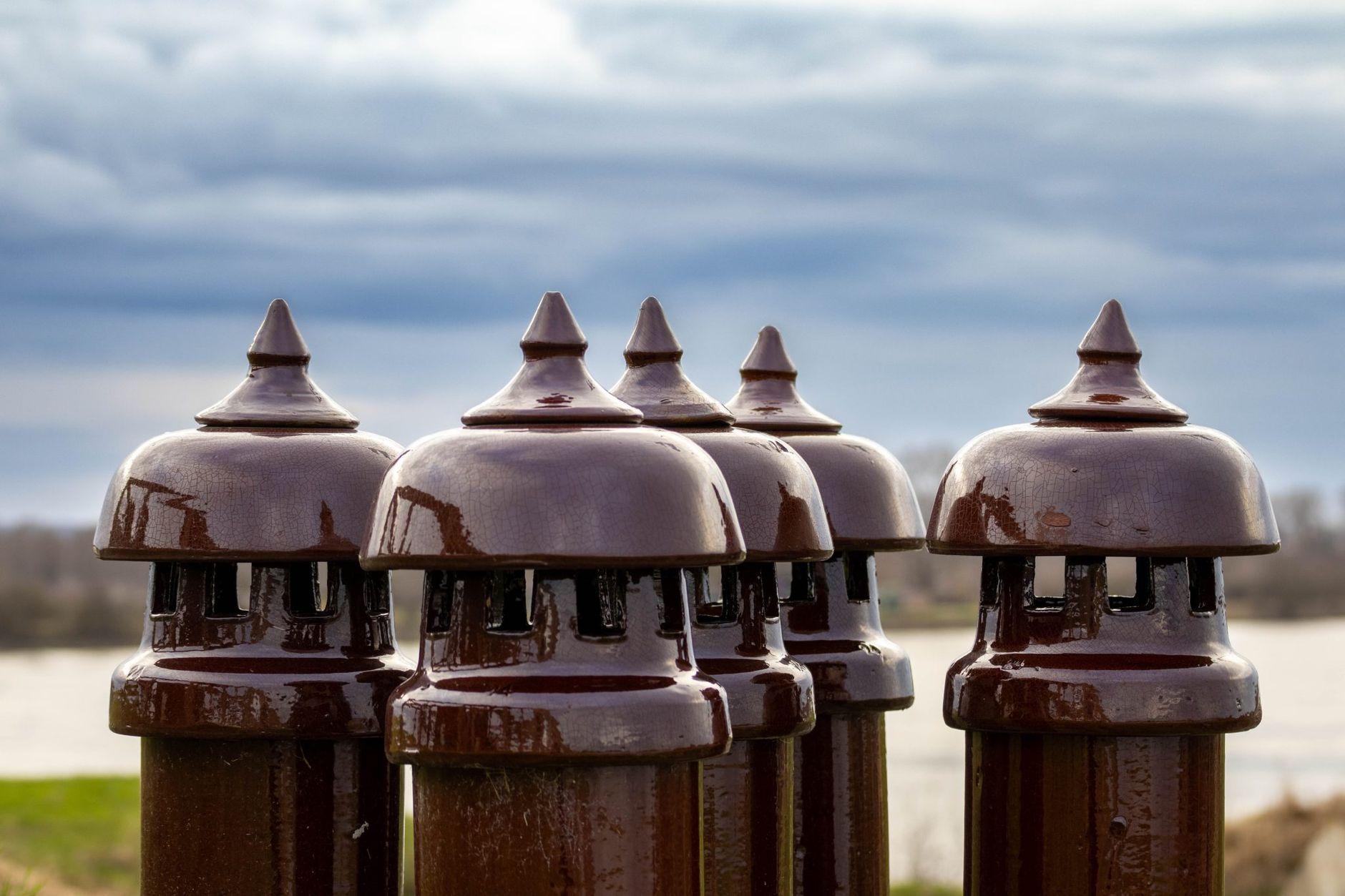
- Cap. The listed termination fitted to the top of the flue pipe itself. Its job is to keep rain and animals out of the pipe, hold sparks in on a wood unit, and let the fireplace draft the way it did when it was tested.
- Storm collar. A ring of metal clamped around the pipe just above the chase top, sealing the gap between the two. It is small and cheap, and it fails often.
A rusted lid does not always mean a bad cap, and a bad cap does not always mean a bad lid. We look at all three on every visit.
How a chase top fails
Most original lids in Corona tracts were plain galvanized steel, formed flat or nearly flat. Flat steel holds water. Standing water eats through the zinc coating, rust starts in the low spot, and in time it pits through. Rain then drips onto the plywood under the lid, down the framing, and onto the outer shell of the firebox.
The signs move inward with time:
- Rust streaks on the stucco or siding below the chase.
- A sagging or dished lid you can spot from the street.
- Water stains on the ceiling or wall near the fireplace after a storm.
- Rust on the damper, the firebox floor or the metal around the opening.
- A musty smell from the fireplace on damp days.
By the time water marks show inside the firebox, the framing under the lid has usually been wet more than once.
When a new lid is enough
If the cap is sound, the storm collar is intact, and the plywood under the lid is still firm, the fix is a new chase top. We replace galvanized with stainless steel, formed with a slight peak or cross break so water runs off, a raised collar at the pipe opening, and a drip hem along the edges. Each one is fabricated for the chase it goes on, because tract builders rarely used one size across a street.
We put a figure in writing once we know the chase size and what lies underneath, since a soft deck under the lid changes the work.
When the cap goes too
The cap comes off whenever the lid is replaced, so the question is whether it goes back on. We replace it when:
- It is rusted, dented or missing its screen.
- It is not the cap the fireplace maker lists for that model.
- A past owner fitted a generic masonry cap to a metal pipe.
- A decorative shroud is wanted to hide the pipe.
The cap matters more on a factory-built unit than on a brick chimney. The maker tested the fireplace with a specific termination, and the draft, spark control and wind behavior were measured with that part on. A substitute may fit the pipe and still be wrong for the system.
What it costs
We size the flue before we name a figure for any cap. Copper, or a crown wider than most, moves that figure. A plain round cap listed for one pipe is the simplest job. A decorative shroud covering a wide chase, built to the house, costs the most.
When water has already reached the framing, the job becomes a leak repair. Tracing the entry and putting it right runs $545 to $3,250 with us, depending on how much wet material has to come out and be replaced.
If you can see the lid from the yard, tell us what shape it is in and whether the stucco below it is stained. That is enough for us to plan the roof visit and bring the right gear.
Why the fireplace stays off until it is fixed
Water inside a chase does not dry out quickly. It sits against the outer shell of the firebox and the pipe. Rust on a firebox shell weakens the steel that holds heat away from the framing, and a pipe joint that has rusted can let exhaust into the chase. Neither shows from inside the room. Until the lid, collar and cap are sorted, the safest step is not to light the fireplace.
The visit, in short
On the roof we look at the lid, the storm collar, the cap and the siding around the chase. In the attic we look at the framing around the pipe for stains or soft wood. Inside we check the firebox shell and damper for rust. You get a written list of what we found and a price for each item, with the listed cap part named where the cap is being replaced.
More detail is on our chase cover, cap installation and leak repair pages. If you are weighing the whole fireplace rather than the top of it, our prefab repair cost guide covers the rest of the system.
Rust lines on the stucco are a good reason to stop guessing. Reach us through the contact page and tell us how long the streaks have been there.
Rather Have the Unit Identified and Priced?
Danforth Chimney Care finds the label plate, checks the unit against its manual and lists the parts it needs with prices. Visits run from Corona to Anaheim, Tustin, Diamond Bar and the towns between.